Nanofluidic tools for observing and controlling the conformation, position, and dynamics of individual biomolecules.
01
Platform development
Reversible electrokinetic confinement
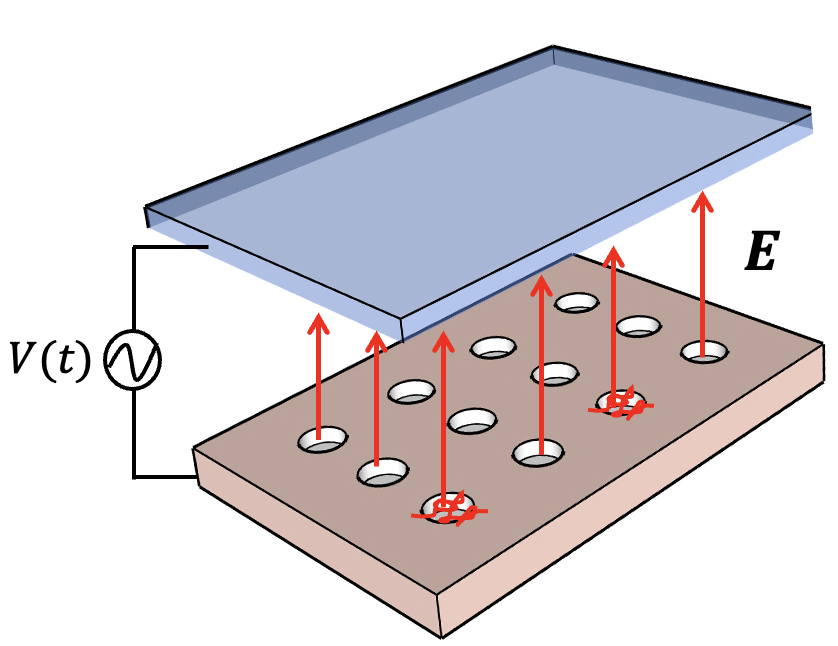
RECON uses patterned dielectric nanowells between parallel electrodes to create localized, electrically tunable free-energy landscapes.
DNA begins in bulk solution. When an alternating field is applied, the nanowells act as attractive potential wells that capture and confine the molecule. Removing the field releases it. Changing the frequency and amplitude of the drive changes the strength and dynamics of confinement without mechanically closing the device.
Systems
λ-DNA, T4-DNA, liposomes, DNA nanotubes
Control
Frequency, amplitude, waveform, time
Readout
Single-molecule fluorescence microscopy
RECON device geometry and electrically defined nanocavity confinement.
02
Non-equilibrium biophysics
Driven polymer conformations
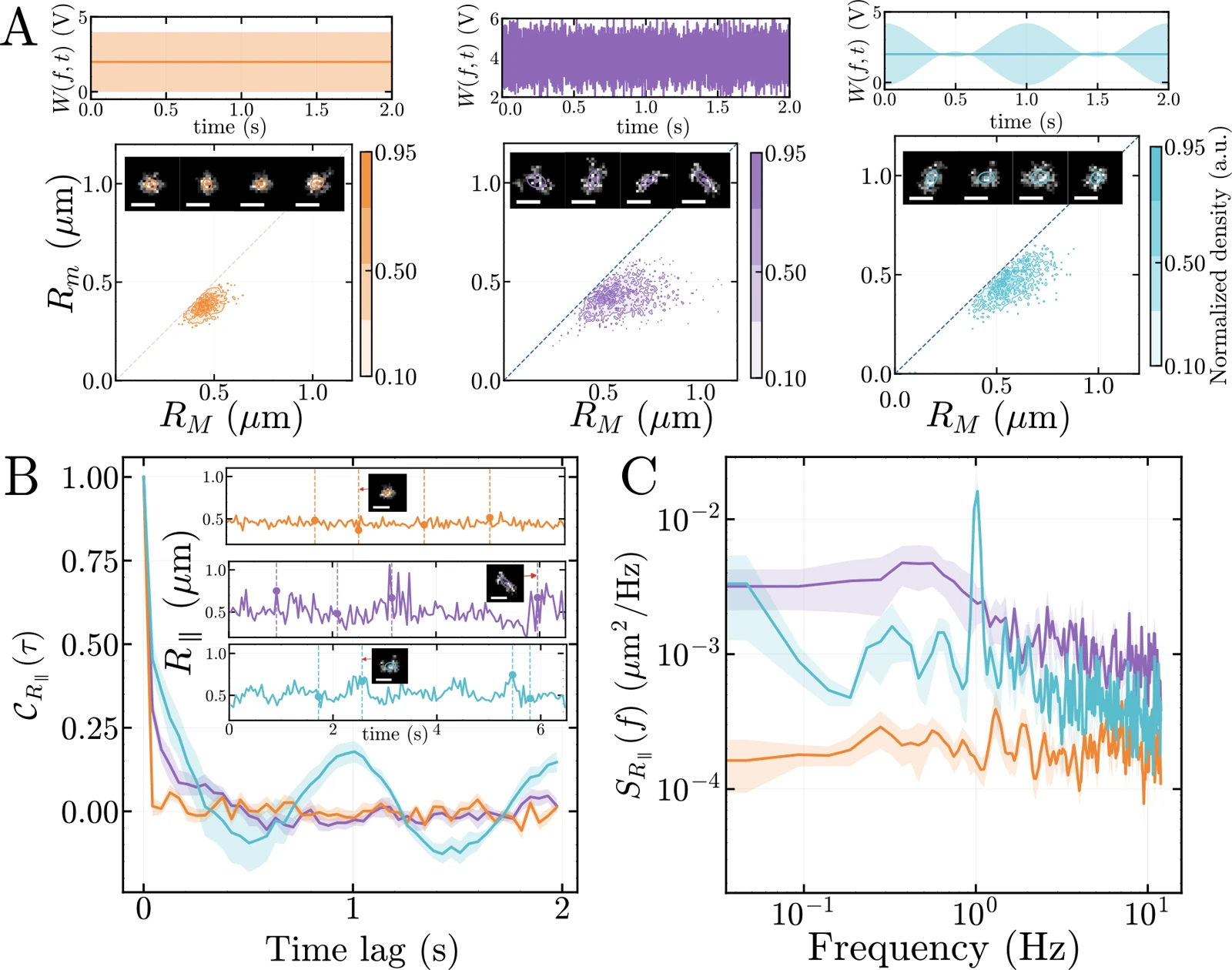
A time-dependent confinement landscape turns a single DNA molecule into a directly observable non-equilibrium system.
We apply periodic and stochastic waveforms and quantify the response through the radius-of-gyration tensor, shape anisotropy, relaxation, phase lag, and hysteresis. Experiments are compared with molecular simulations to identify which modes of the polymer are being driven and where simplified descriptions break down.
Frequency-dependent conformational response
Hysteresis in major- and minor-axis dynamics
Experiment–simulation comparisons
Stochastic transitions between nanocavities
Polymer conformations and dynamics under constant, stochastic, and periodically modulated drives.
03
Broader applications
Nanofluidic analysis across molecular systems
Tunable fields and nanoscale structures provide a common language for studying polymers, membranes, and molecular assemblies.
Related work includes digital nucleic-acid analysis, dual-nanopore DNA dynamics, electrokinetic liposome confinement, and plasmonic nanocavities for Raman-based characterization. The unifying goal is to build physical tools that preserve single-particle information while making molecular states measurable and controllable.
Research aimBuild experimental systems in which molecular dynamics are not only observed, but deliberately programmed.